
By Síle Rooney
When I was diagnosed with Sjögren’s in 2017, I was told it would probably be arelatively quiet disease: mainly dry eyes, dry mouth and fatigue. For a while, that was my experience.
Over time, I realised there was more to understand about my own version of Sjögren’s. Both my personal journey and this year’s International Symposium on Sjögren’s Disease (ISSjD) in Paris taught me that there is no single Sjögren’s story.
That understanding has been reassuring and empowering.
Looking for expertise
My doctors in Ireland are excellent and continue to lead my care. As my questions became more complex, however, I looked for a centre experienced in Sjögren’s and its less common manifestations. That search led me to Hôpital Bicêtre in Paris, a French national reference centre for rare autoimmune diseases. A consultation there influenced how my care is being considered and left me feeling understood by clinicians who see complex Sjögren’s every day. It also showed me the value of European collaboration: patients can benefit from expertise wherever it sits.
A room full of people working on it
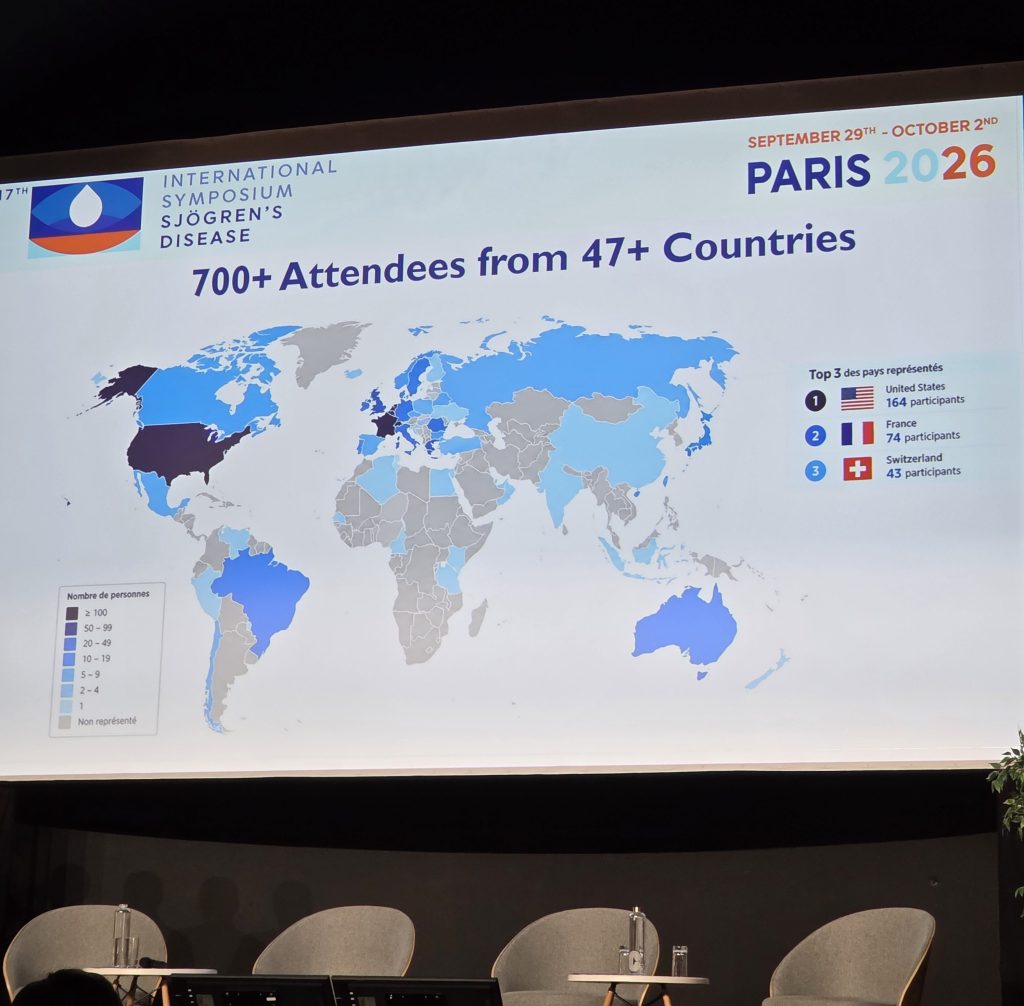
The Bicêtre team suggested I attend ISSjD 2026. For four days, I sat with hundreds of researchers, clinicians and healthcare professionals dedicated to understanding Sjögren’s. Some of the science was challenging—there were unfamiliar acronyms, dense graphs and many photographs of slides on my phone—but the experience was unexpectedly reassuring.
Everywhere I looked, people were asking why Sjögren’s varies so widely, how active disease can be recognised earlier, and which treatments work best for different patients.
Researchers were candid about what is known, what remains uncertain and where more work is needed. That honesty increased my confidence in the field. It was also heartening to see Irish institutions and Sjögren’s Ireland represented, reminding me that patients here are part of a much larger international effort.
Sjögren’s has many faces
Sjögren’s is highly variable. Some people experience mainly dryness; others live with fatigue, joint pain, gland swelling or involvement of the nervous system, skin, lungs, kidneys, blood vessels or other organs. For example, children may initially have swollen glands and joint symptoms rather than dry eyes or mouth, while some patients lack the antibodies usually tested first. This variety helps explain delayed diagnosis, fragmented specialist care and why a person’s experience remains valid even when it does not fit the expected pattern.
Symptoms, disease activity and informed care
How someone feels and what the disease is doing are not always the same: feeling reasonably well does not rule out active disease, while feeling very unwell does not necessarily mean organ damage. Clinical review, blood tests and urine tests can reveal what symptoms alone cannot.
For me, understanding the disease is not about becoming anxious; it is about being informed. Discussions of organ involvement, lymphoma risk and other complications explained what clinicians monitor and which changes may need attention. Most people with Sjögren’s will never experience serious complications, but research presented at the meeting suggested that prolonged systemic activity may contribute to long-term damage in some patients. That reinforces the value of timely investigation and thoughtful decisions with your healthcare team.
Treatment: cautious reasons for hope
After many years of limited progress, treatments are producing encouraging results. A recurring theme at the symposium was that Sjögren’s encompasses different disease patterns, so treatment may increasingly need to be matched to the individual patient and manifestation. Established and newer therapies are being investigated in clinical trials, with several studies reporting promising findings. However, the evidence is still evolving and some groups remain under-represented, including patients with kidney involvement. Much remains to be done for rarer manifestations, but researchers are beginning to understand not just whether treatments work, but which may work best, for whom, and why.
Patients matter
Patients were presented not simply as recipients of care, but as partners who help shape studies, improve outcome measures and identify questions clinicians might otherwise miss. That partnership can support better research and shared decisions.
If you’re on a similar path
A few practical lessons stood out for me:
Be informed and prepare. Understand what is being monitored, bring your
questions and be open about the expertise or support you need.
Keep your records. Test results, clinic letters, imaging and biopsy reports
can reveal trends and help if you seek another opinion.
Consider research participation. Progress depends on patients taking part.
Add your voice. Join Sjögren’s Ireland, contributing to consultations or
supporting research can help patients play a part in the work still ahead.
Use practical tools. The Dutch Sjögren’s patient community’s SpiderWeb
tool helps people map symptoms and identify priorities before an
appointment. It does not replace medical advice, but it can support more
focused conversations.
Reasons for greater hope
I came home from Paris tired, carrying a long reading list and feeling more hopeful than I expected. No one promised a cure or easy answers, and much remains to be learned, especially about rarer manifestations. I also came home with a clearer sense of the scale of the shared work still ahead for Ireland: building a better picture of Sjögren’s through a national register, bringing expertise together in a dedicated centre, working towards that centre’s membership of ERN ReCONNET—the European Reference Network for rare and complex connective tissue diseases—and further developing the evidence and research capacity needed for better care and access to new treatments. These are long-term ambitions that will require patients, advocacy groups, clinicians, researchers and decision-makers to work together. The symposium showed me what that kind of collective effort can make possible.
If you live with Sjögren’s, you are not as alone as it can sometimes feel.
The views in this post are my own. I am deeply grateful to the researchers, clinicians and patient advocates working to improve understanding and care for people living with Sjögren’s, and to the doctors in Ireland and France who have supported me on my own journey. Finally, I would like to thank Deirdre Collins and Dr Joan Ní Ghabhann-Dromgoole, whose dedication, advocacy and leadership have helped raise awareness of Sjögren’s and provide invaluable support to the community in Ireland.


Leave a Reply